
Email: [email protected]


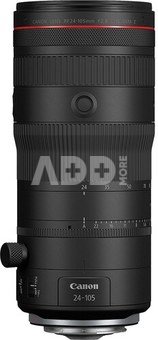
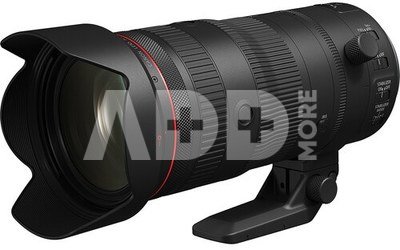
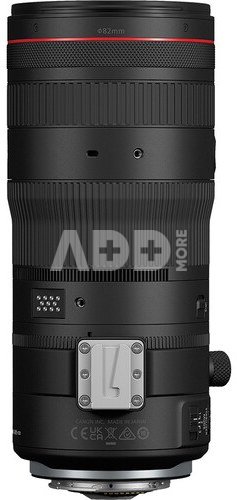
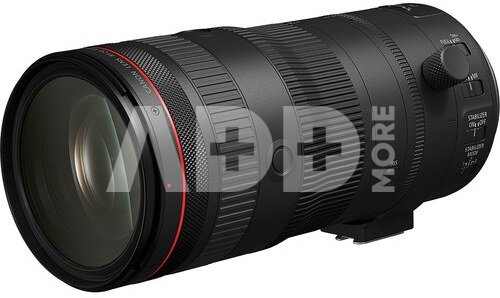
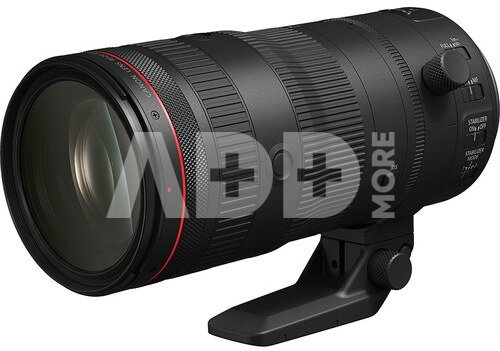
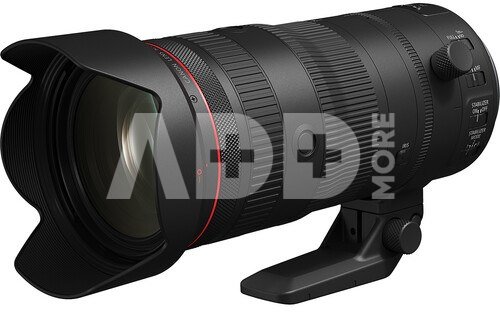
The Canon RF 24-105mm f/2.8 L IS USM Z lens is one of Canon's most versatile lenses. Its wide focal length range and ultra-fast aperture make it suitable for a variety of photography needs. Thanks to its advanced optics and autofocus capabilities, this lens delivers stunning image quality. Those who are familiar with Canon lenses ask what the "Z" stands for, so let's answer that question right away! This lens is compatible with the Canon Power Zoom Adapter PZ-E2 and PZ-E2B adapters and has their mounting points and contacts. These devices allow motorized control of the conventional Z lens zoom ring. This lens is designed for professional video content creators, video production specialists and enterprises, and serious enthusiasts of portraits, events and weddings, photojournalism, high-end YouTube and in-house production.
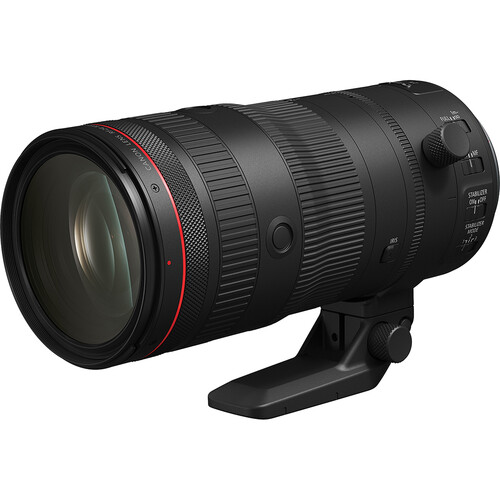
Focal length range (or the individual focal length of the prime lens) is a key criterion to consider when buying or selecting a lens. In order to frame your desired subject from an optimal perspective or within your working distance, you need a certain angle of view. The 24-105mm range goes well beyond the optimal general purpose range (around 28-70mm on a full-frame camera), especially in the portrait range. Especially with its f/2.8 aperture, this lens is a great choice for people photography, including outdoor and studio portraits, weddings, parties, events, documentaries, interviews, lifestyle, fashion, sports (for close-up shots or to capture the overall picture), candid photos, group portraits, and environmental portraits. This focal length range is a great choice for photojournalism, capturing a variety of product shots, and is generally great for commercial photography. The 24-105mm range is ideal for landscape photography. The 24mm perspective makes it easy to create compelling landscape compositions, while highlighting the foreground subject against a focused background, leaving the viewer feeling like they are in the scene. At the other end of the range, the 105mm is great for moderately compressed landscapes, where distant objects like mountains remain large in the frame. This lens is a great choice for video production, and its intended use is consistent with its photography purpose. On an APS-C sensor camera, the 1.6x FOVCF (field of view crop factor) gives a similar angle of view to a 36-157.5mm lens on a full-frame camera. This range lacks a bit in terms of wide-angle, but it has a very attractive long end, especially useful for portraits.

What is the second most important question when choosing a lens? The answer is usually this: how much light does the lens transmit to the image sensor? Few zoom lenses open wider than f/2.8, and no other lenses at this focal length open to f/2.8. The larger elements required to create such an aperture reduce size, weight and cost, but the benefits are significant. Compared to the f/4 alternative, the f/2.8 aperture offers 1 stop lower ISO for the same shutter speed, improves AF in low light, and allows for stronger background blur. This lens is a great choice for action and events taking place in low light. The RF 24-105 F2.8 features a smoothly integrated stepless manual aperture ring - a feature that is particularly sought after by videographers. When the ring is in the A (auto) position, the camera controls the aperture setting, while all other settings force the aperture to the selected aperture. The aperture lock switch holds the aperture ring in the A setting to prevent accidental changes. Please note that camera compatibility is required, and you must have a 2024 or later EOS R series camera model to use this ring for shooting.

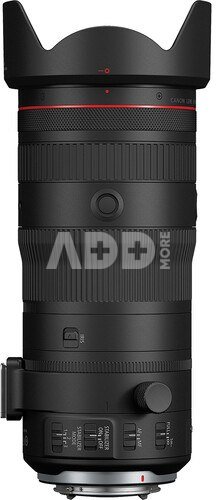
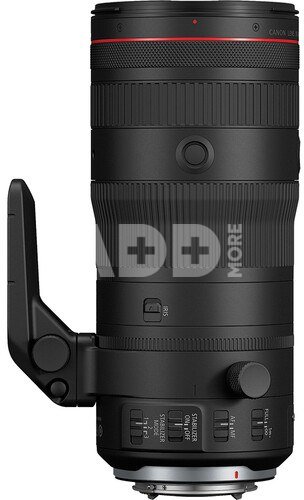
Image stabilization is another great feature of this lens. The IS system has an assist factor of 5.5 stops, while the IS coordinated with IBIS is 8.0 stops. The three stabilization modes are a first for a Canon RF standard zoom lens. Mode 1 (general purpose), Mode 2 (panning with the subject, single axis of stabilization provided) and Mode 3. Mode 3 is useful for tracking shaky action. In this mode, image stabilization is active and ready to use the moment the shutter is released, but actual stabilization does not take effect until that precise moment. As a result, the image seen through the viewfinder is not stabilized, so you can track a moving subject without having to fight with the IS trying to stabilize the image. Mode 3 is designed to detect panning motion, and when it is detected, the lens will only apply stabilization at right angles to the direction of the detected motion (as in Mode 2). When the alternative is to increase ISO, the difference in noise that IS allows for still subjects is huge, and stabilization greatly improves image quality.
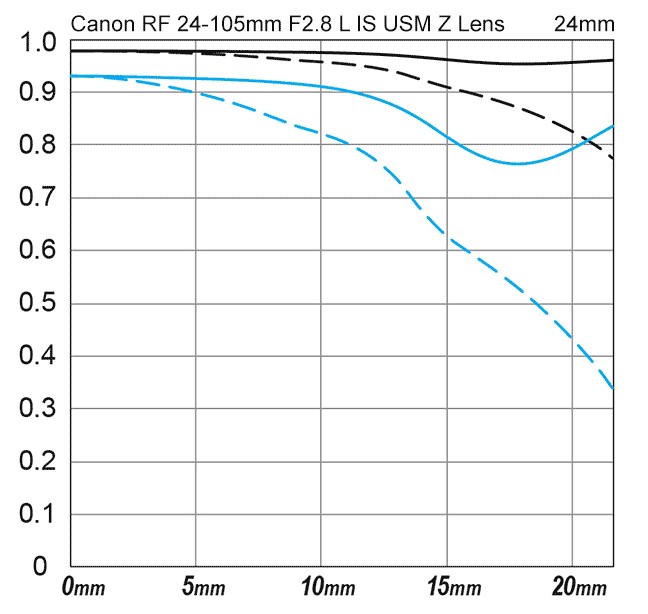
The Canon RF 24-105mm F2.8 L IS USM Z lens is a record-breaking focal length and aperture combination. The logical question is, how does pushing the limits affect image quality? Canon engineers focused on advanced photographers when developing this design and know that anything less than excellent optical performance would be unacceptable. For comparison, here are the MTF plots for the Canon RF 24-105mm F2.8 L IS USM Z lens (A) and the highly regarded Canon RF 24-70mm F2.8 L IS USM lens (B). The black lines indicate contrast, while the blue lines indicate resolution. The solid lines are sagittal, while the dashed lines are meridian. The higher the lines, the better the optical performance. At 24mm, the RF 24-105 F2.8 appears sharper than the RF 24-70 F2.8 in the center and middle of the frame. When comparing angles, the two lenses generally perform similarly. At the long edge, both lenses perform similarly. The 24-105 has a slight advantage in the center, and the 24-70 in the corner. However, 105mm is not 70mm, and the 24-105 may be superior at this mid-range setting. We'll have to wait and see. This lens features Canon's SSC (Super Spectra Coating) and ASC (Air Sphere Coating), an ultra-low refractive index coating composed of air and silica designed to combat flare and ghosting.
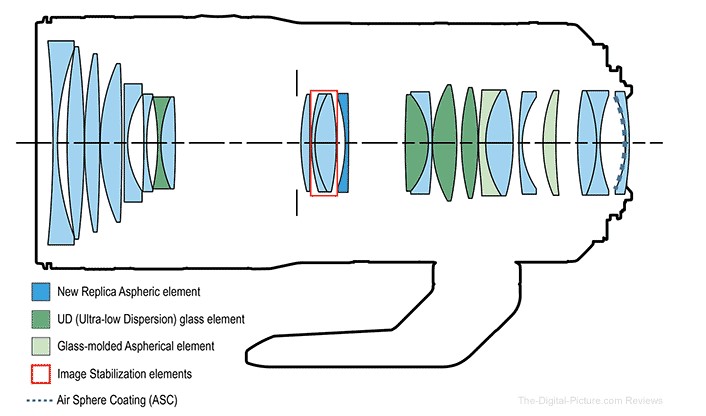
This lens features twenty-three elements, including advanced materials and shapes. There are 3 aspherical elements and 4 UD elements. What is a "New Aspherical Element"? We've used "replica" aspherical elements before... The concept is this: an optical material (think of it as an easily moldable, almost viscous liquid) can be bonded to one surface of the element (obviously hardened in its final form). The idea is that a complex aspherical shape can be applied to a specific element and allow it to perform its task(s) more effectively than a conventional glass-formed element could." "The new aspect is that here this "coating" (certainly not like the coatings on traditional lenses!) can be thicker, contoured into an even larger aspherical shape, and most importantly Canon has developed new surface measurement and manufacturing techniques that allow for greater precision than before." {Rudy Winston, Canon USA}
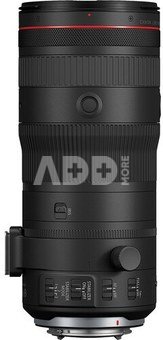
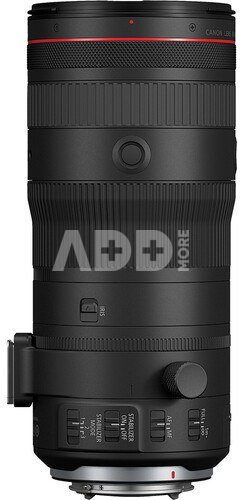
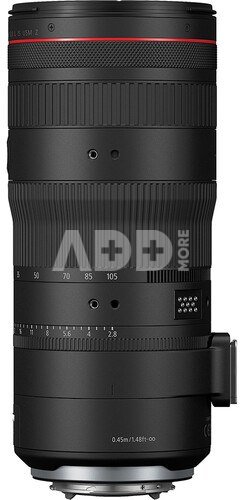
A dual Nano USM powers the Canon RF 24-105mm F2.8 L IS USM Z lens's AF. This system is fast, quiet, internal and smooth. The f/2.8 aperture means you can expect excellent AF performance in low light. FTM (Full Time Manual) focusing is supported in AF mode when the camera is in One Shot Drive mode, but the shutter release button must be pressed halfway for the focus ring to become active. Note that FTM does not work if electronic manual focus is disabled in the camera menu after One Shot AF mode. The lens switch must be in the "MF" position and the camera's meter must be on/standby to use normal manual focus. This lens features a two-position focus distance range limit switch that not only allows the full focus distance range to be used, but also limits the distance selection to 3.3' (1.0 m) - ∞, with a narrower range that can shorten focus lock time. There are two lens function buttons in convenient positions for use in horizontal and vertical orientations. By default, the buttons perform an AF stop function, locking focus at the currently selected distance, allowing for the use of focusing and recomposing techniques. However, they can be programmed for many other functions. This lens operates similarly to a parfocal, so subjects remain in focus as you change focal length. The large, rubber-rimmed manual focus ring is optimally positioned at the front of the lens. Canon states that this lens has excellent focus breathing (lack of focus) characteristics. This lens has a minimum focusing distance of 17.7" (450mm) at all focal lengths, and at 105mm it produces a large 0.29x maximum magnification, which is especially useful for capturing details and other small subjects. At 24mm, an object measuring approximately 16.0 x 10.7" (408 x 272mm) will fill the full-frame image sensor at this lens's minimum MF distance. At 105mm, an object measuring approximately 4.8 x 3.2" (121 x 80mm) will do the same.
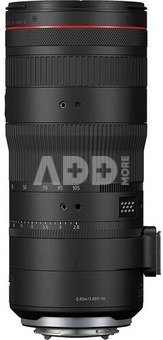
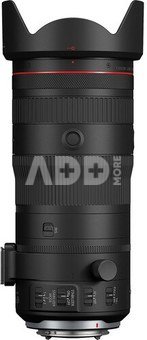
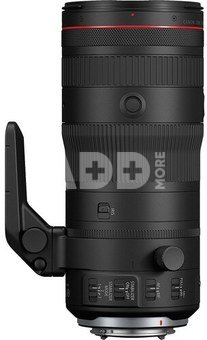
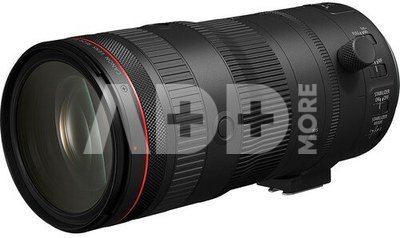
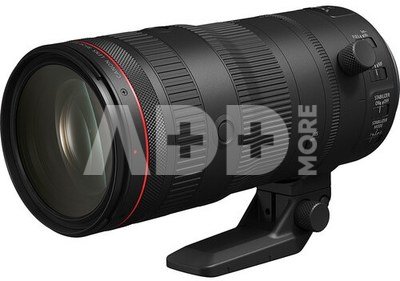
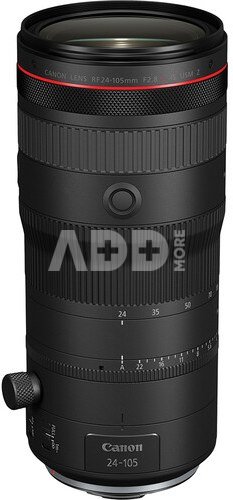
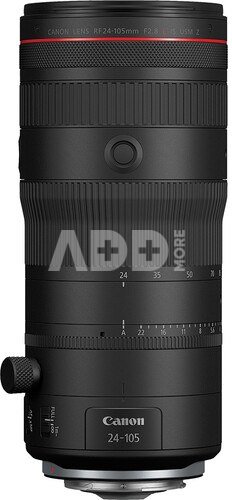
The RF 24-105mm F2.8 L IS USM Z is Canon's largest black RF L-series lens. It looks sharp and is designed for professional use. The outer diameter of this lens is mostly the same. A slight increase in width starting at the center of the focus ring makes it easier to grip. Unlike most standard zoom lenses, this lens doesn't change size, helping to maintain a stable balance. The textured control ring at the front of the lens is configurable for quick access to camera settings, including aperture, ISO, and exposure compensation. Note that the control ring is depressed by default. Expect the clicks of this ring to be audible in the camera's audio recordings. Canon offers a click brake removal service (for a fee). The four switches are Canon's current standard flush-mount design, with enough raised area to be usable with gloves. The two IS-related switches are located on a slightly raised area on the lens. Expect each switch position to be truly depressurized.

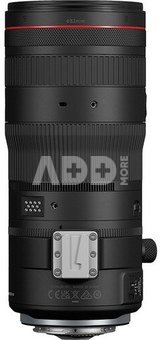
This lens is built to resist dust and moisture, including seals on the power zoom adapter contacts and connector areas. The front lens element is coated with a fluorine coat that repels fingerprints, dust, water, oil, and other contaminants, making cleaning much easier. Compared to the standard professional zoom lenses we’re used to, and even compared to the RF 70-200 F2.8, the RF 24-105 F2.8 is large and heavy. However, it’s the same size as the EF 70-200mm F2.8 lens that many of us have used for hours on end for years. In many cases, the combination of the 24-105mm focal length range and f/2.8 aperture is worth the size and weight.
With eleven aperture blades and a large f/2.8 aperture, the Canon RF 24-105mm F2.8 L IS USM Z produces a beautiful, almost circular bokeh effect - even when stopped down. The wide aperture also allows for faster shutter speeds in low light and helps prevent subject blur.

Focal Length: 24-105 mm
Aperture: f/2.8
Manufacturer: Canon
Lens Mount: RF Mount
Color: Black
Compatible Cameras: Canon EOS R series, full-frame and APS-C (focal length equivalent to approximately 38.4-168 mm when used with APS-C camera)
Minimum Focusing Distance: 0.45 m
Maximum Magnification: 0.08x (at 24 mm), 0.29x (at 105 mm)
Lens Construction: 23 elements, 18 groups; 4 UD elements, 3 aspherical elements
Lens coating: Canon SSC (Super Spectra Coating), ASC (Air Sphere Coating), Flourine coating
Filter diameter: 82 mm
Number of aperture blades: 11
Image stabilization: 5.5 stops correction with in-lens optical image stabilization (8.0 stops correction with EOS R series body-integrated image stabilization)
Focusing: Focus drive system - two Canon Nano USM focus motors; full-time manual focus available (both ONE SHOT AF and SERVO AF supported with compatible EOS R series cameras); Dual Pixel CMOS AF coverage (horizontal and vertical): EOS R/RP/Ra/R100 - Approx. 88% x 100%, EOS R5/R6 - with Face + Tracking Priority AF: Approx. 100% × 100%, other than Face + Tracking Priority AF: Approx. 90% × 100%, EOS R3, R6, Mark II, R8 R7, R10, R50 - Full-area AF: Approx. 100% × 100%, non-full-area AF when subject detected: Approx. 100% × 100% when subject not detected: 90% × 100%
Focus/Control Ring: Yes, with click stops (click stops can be removed at a Canon Service Center for an additional fee)
Manual Focus Ring: Electronic ring system. Full manual focus possible. There are no physical limitations on the angle of rotation of the ring.
AF/MF switch: Yes
Dimensions: maximum outer diameter x length is approximately ø88.5 mm x 199 mm
Weight: approximately 1330 g
Lens mount (bayonet) Canon RF
Focal length (wide) 24 mm
Focal length (tele) 105 mm

| Producer(?) | Canon |
|---|---|
| Lens mount (bayonet) | Canon RF |
| Type | |
| Focal length (wide) | 24 mm |
| Focal length (tele) | 105 mm |
| Max Aperture | 2.8 F |
| Minimum Focus | 45 cm |
| Image stabilization | 5.5 stops correction with in-lens optical image stabilization (8.0 stops correction with EOS R series body-integrated image stabilization) |
| Stabilization | Yes |
| Размер кадра | |
| Filter size | 82 mm |
| Diameter | 88.5 mm |
| General | |
| Warranty | 24 months |
| Dimensions (length) | 199 mm |
| Color | black |
| Delivery time | 5-19 w.d. |
| Focus | two Canon Nano USM focus motors; full-time manual focus available |
| Korpusas | |
| Construction | |
| Weight | 1330 g |
| Dimensions (mm) | 88.5 mm x 199 mm |
| Product codes |
10831KVG 454929222315 |


Email: [email protected]

Reviews
0 average rating (0 votes)